
 NEWS List
Mastering Cable Routing Around Bends in Underground Installations
Introduction
In underground cable installation, straight runs are relatively simple. The true engineering challenge begins when a cable must pass through a 45° turn, a 90° corner, or a complex series of bends in trenches, duct banks, and manholes. At these directional changes, pulling tension rises sharply, sidewall pressure increases, and the risk of cable damage multiplies.
Why Bend Radius Is the #1 Enemy of Cable Longevity
Every power and communication cable has a minimum allowable bend radius. Exceeding this limit by forcing the cable into too tight a turn can permanently damage:
Insulation layers
Conductors
Shielding
Fiber optic cores
Outer jackets
Unlike visible cuts or abrasions, bend damage often remains hidden until the cable is energized, causing failures months or years later.
Common Consequences of Improper Bending
Cracked XLPE insulation
Conductor deformation
Increased partial discharge
Signal attenuation in fiber optic cables
Reduced service life
Costly replacement and downtime
For this reason, cable routing around bends is one of the most critical aspects of underground installation.
The Science of Cable Bending
Most manufacturers specify minimum bend radii based on cable outer diameter (OD).
Rmin=15DR_{min}=15DRmin=15D
Where:
RminR_{min}Rmin = minimum bend radius
DDD = cable outer diameter
Typical guidelines include:
Medium-voltage power cables: 15 × OD
Fiber optic cables: 20 × OD
Control cables: 10–12 × OD
Example Calculation
For a cable with an outer diameter of 60 mm:
Minimum bend radius = 15 × 60 mm = 900 mm
Any bend tighter than 900 mm may cause irreversible damage.
How Rollers Reduce Bending Stress
Corner rollers and pulley blocks distribute cable load over multiple wheels, transforming sharp directional changes into smooth arcs. This reduces:
Sidewall bearing pressure
Pulling tension
Jacket friction
Mechanical strain
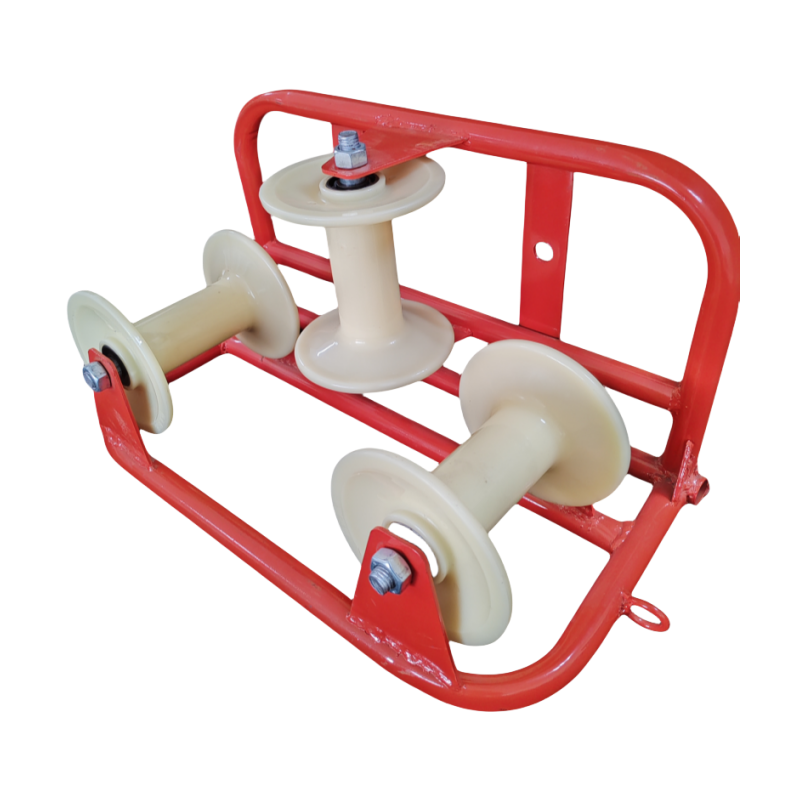
Corner Cable Roller Designs Explained
Different installation environments require different corner roller configurations.
Single-Wheel Corner Rollers
These units are designed for fixed-angle turns such as:
45° bends
90° bends
Features include:
Heavy-duty steel frames
Large nylon wheels
Sealed bearings
Compact design
Ideal for small and medium cable pulls.
Multi-Wheel Corner Roller Assemblies
Configurations such as 3-wheel or 5-wheel assemblies create a broader support arc, reducing pressure on large-diameter cables.
Advantages:
Better load distribution
Lower sidewall pressure
Suitable for heavy MV/HV cables
Adjustable-Angle Corner Rollers
These systems can be configured to fit non-standard angles, making them useful in irregular trenches or crowded utility corridors.
Trench Corner Rollers vs. Manhole Corner Rollers
Type Typical Use
Trench corner roller Ground-level turns in open trenches
Manhole corner roller Cable entry and direction changes inside manholes
Duct corner roller Routing at conduit exits
Vertical transition roller Changes from vertical to horizontal
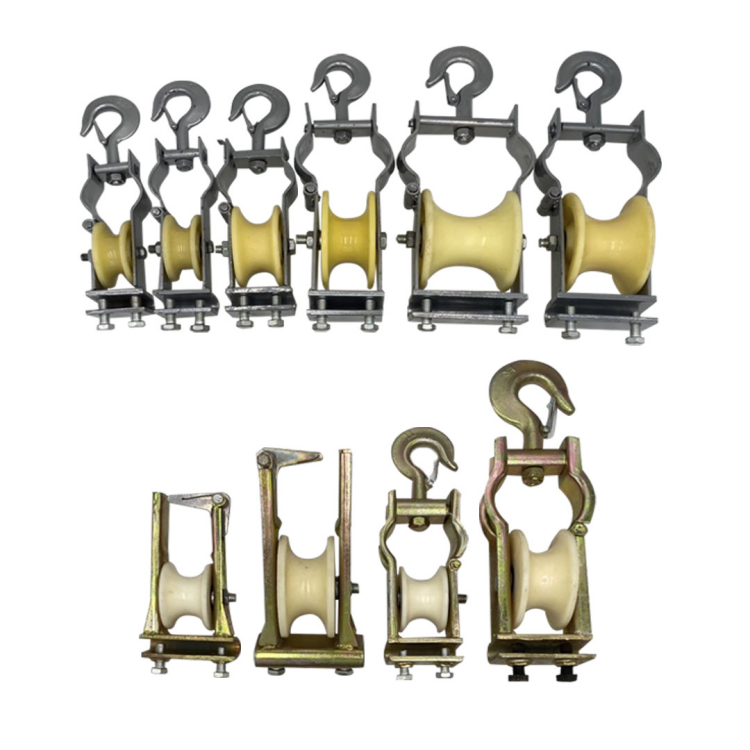
Nylon Cable Guide Pulley Blocks for Heavy Routing
A cable pulley block is a robust roller assembly with a large-diameter sheave designed for high-tension cable pulls.
Key Components
Nylon sheave (pulley wheel)
Steel side plates
High-capacity bearings
Suspension hook or mounting frame
Sheave Diameter Selection
Larger sheaves produce gentler cable bends and lower stress.
Typical recommendations:
Cable OD Minimum Sheave Diameter
20–40 mm 200–300 mm
40–80 mm 300–500 mm
80–150 mm 500–800 mm
Bearing Types
Sealed Ball Bearings
Low maintenance
Smooth rotation
Resistant to dirt and moisture
Roller Bearings
Greater load capacity
Suitable for very heavy pulls
Load Capacity Ratings
Common capacities include:
1 ton
3 tons
5 tons
10 tons and above
Selecting the correct rating ensures structural integrity under maximum pulling tension.
Application Scenarios
Trench Direction Changes
At 90° turns in duct banks, corner rollers prevent the cable from rubbing against concrete edges and trench walls.
Manhole-to-Manhole Routing
In urban utility networks, cables often pass through several bends. Multi-wheel roller sets maintain proper curvature throughout the pull.
Vertical-to-Horizontal Transitions
At shaft exits or riser entries, transition rollers protect cables from sharp directional changes.
Routing Around Existing Obstacles
Corner rollers help navigate around:
Existing conduits
Water lines
Gas pipes
Structural foundations
Installation Best Practices for Corner and Pulley Applications
Use Multiple Rollers Around Tight Bends
Instead of forcing a cable over one point, use several rollers to form a gradual curve.
Secure the Equipment
Anchoring options include:
Ground spikes
Sandbags
Chain restraints
Clamp-on brackets
Align Entry and Exit Paths
Ensure smooth transitions between straight rollers and corner assemblies.
Conduct Pre-Pull Testing
Before pulling:
Rotate all wheels manually
Verify bearing performance
Inspect frames for damage
Confirm alignment and anchoring
Why Nylon Outperforms Alternatives at Bends
Nylon is the preferred sheave material for most cable roller applications.
Self-Lubricating Surface
Nylon naturally reduces friction, allowing cables to move smoothly without damaging the jacket.
High Impact Resistance
It withstands shock loads caused by start-stop pulling and fluctuating tension.
Non-Conductive and Corrosion Resistant
Unlike metal wheels, nylon does not rust or conduct electricity.
Lightweight Yet Strong
Nylon offers an excellent balance of structural strength and easy handling.
Material Comparison
Material Advantages Limitations
Nylon Low friction, durable, non-conductive Not ideal for extreme temperatures
UHMWPE Extremely low friction Lower stiffness
Aluminum Lightweight, precise May scratch cable jackets
Steel Highest strength Heavy, corrosive, higher friction
For most underground cable installations, nylon provides the best overall performance.
Cost-Benefit Analysis
Equipment Investment
A complete set of corner cable rollers and pulley blocks represents a modest investment compared with project costs.
Cost of Cable Damage
Replacing damaged medium-voltage cable can involve:
New cable procurement
Excavation and splicing
Testing and commissioning
Project delays
These costs can easily exceed tens of thousands of dollars.
Labor Savings
Proper rollers offer:
Faster pulling
Reduced manpower
Lower winch loads
Fewer interruptions
Extended Cable Life
Maintaining safe bend radii improves long-term reliability and reduces maintenance costs.
Selecting the Right Corner Cable Roller
When choosing equipment, consider:
Cable diameter and weight
Minimum bend radius
Pulling tension
Bend angle
Installation environment
Required load capacity
For large-diameter utility cables, multi-wheel nylon pulley assemblies with sealed bearings are often the most effective solution.
Conclusion
Bends are the most hazardous points in any underground cable installation. Without proper support, excessive bending and sidewall pressure can cause hidden damage that shortens cable life and increases maintenance costs.
Corner cable rollers and nylon pulley blocks solve this problem by guiding cables smoothly around directional changes while maintaining safe bend radii. Their low-friction nylon sheaves, durable bearings, and heavy-duty frames reduce pulling tension, protect cable jackets, and improve overall installation efficiency.
Whether routing cables through trenches, manholes, duct banks, or around underground obstacles, these specialized tools are essential for safe, reliable, and cost-effective cable installation.
Article Source
Adapted from the following industrial product titles and technical applications:
Corner Cable Roller Nylon Cable Guide Pulley for Cable Routing Around Bends
Cable Pulley Block Roller for Underground Cable Pulling and Laying Applications
Various Single Cable Pulley Roller for Power Cable Installation and Trench Work
Suggested publication reference: Power Engineering Magazine